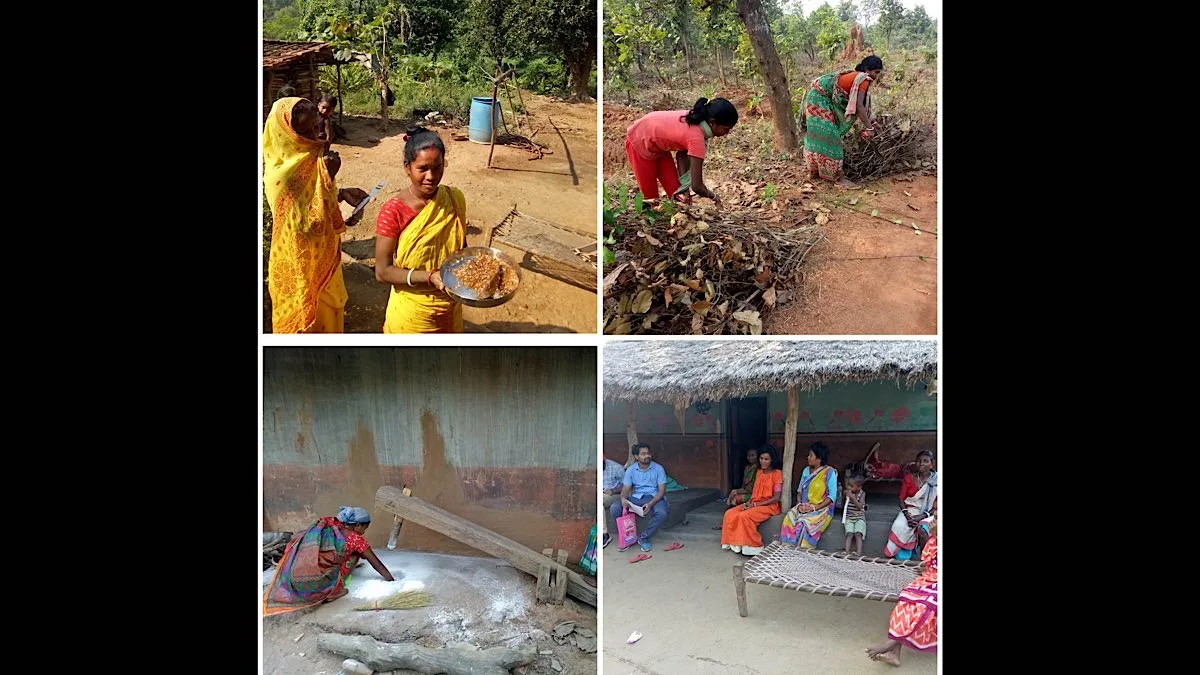
In the red-soil villages and forest fringes of Junglemahal, dawn arrives long before the sun touches the sal and mahua trees. Women step out into the cool morning air carrying baskets, sickles and water pots, beginning a day that will stretch from agricultural fields to forest paths and finally to the hearth of their homes. Their labour is constant, their responsibilities multiple, and their voices often unheard. Yet these women—farmers, forest gatherers, mothers and wage workers—have become the quiet force behind a region gradually emerging from decades of poverty, conflict and neglect.
Once synonymous with insurgency and fear, the names of villages such as Lalgarh, Ramgarh, Netai and Bhimpur carried the weight of a troubled past. In the forested belts of West Midnapore and Jhargram districts, the years of Maoist violence left communities trapped between security forces and insurgent groups. Explosions, gunfire and political uncertainty shaped everyday life, and development remained distant.
Advertisement
Today the atmosphere has changed. Though economic hardship persists, the spectre of violence has receded and daily life has begun to reclaim its rhythm. Villagers move more freely across markets and forest roads, children attend schools, and agricultural cycles have resumed with renewed stability. At the centre of this fragile transformation are the women of Junglemahal, whose labour sustains both household economies and local agriculture.
For most families, livelihoods remain precarious. Farming small plots of land, collecting dry firewood from forests and working as daily wage labourers form the backbone of rural survival. The reality of poverty is stark. In Nayagram of Jhargram district, 53-year-old Balki Hembram sits beside an empty cooking pot in the early afternoon, waiting for her husband to return from selling bundles of firewood in the market so that rice can be purchased for the evening meal. For families like hers, the margin between sustenance and hunger remains painfully thin.
Yet subtle changes are taking root, particularly through welfare schemes that seek to place economic resources directly in the hands of women.
Welfare schemes and women’s financial agency
One of the most significant policy interventions in West Bengal in recent years has been the Lakshmir Bhandar scheme introduced by the state government. The programme provides monthly financial assistance to women from economically weaker households, particularly those belonging to landless families, Scheduled Castes and Scheduled Tribes.
In regions like Junglemahal, where women traditionally manage household expenditure but rarely control formal income, such direct financial transfers have begun to alter spending patterns and decision-making dynamics within families.
A recent field survey conducted across more than one hundred villages in the Junglemahal region covering approximately 600 households indicates that the scheme has had varied but meaningful outcomes. Nearly 78 per cent of marginal and forest-dependent families reported using Lakshmir Bhandar funds to purchase essential commodities such as rice, oil and vegetables. Others channel the money toward agricultural inputs, repayment of small loans, LPG cylinder refills or children’s education.
For many women, the scheme has also created opportunities to save or invest modestly.
Namita Majhi, a resident of Kankabati in West Midnapore district, deposits the monthly amount into a post office account opened in her daughter’s name. In Shaldanga village, Rina Singh uses the financial support to pay for her daughter’s private tuition classes. Meanwhile in Taldi village of Jhargram district, Sonia Tudu has used the funds to begin small-scale poultry farming, gradually building a supplementary income source.
These examples illustrate how targeted welfare programmes can strengthen women’s economic agency within households, enabling them to prioritise children’s education, healthcare and long-term financial stability.
However, gaps in the scheme’s reach remain visible.
Approximately 15 per cent of surveyed households reported that eligible women were unable to access the scheme due to age-related eligibility conditions. In many tribal communities, where early marriage remains common due to economic pressures, young married women often fall outside the programme’s eligibility criteria.
In Bhumij Dhansol village, 22-year-old Babli Sabar is among those who remain excluded. Similarly, Alpana Singh, aged 20 from Betkundri village, faces similar constraints. Their experiences highlight how policy frameworks sometimes fail to reach the most vulnerable segments of rural society.
Dr Pravat Kumar Shit, a researcher at Raja Narendralal Khan Women’s College in Midnapore, believes the scheme carries significant developmental potential but requires targeted implementation.
According to him, Lakshmir Bhandar can serve as an effective tool for uplifting economically marginalised communities if the programme is expanded carefully. He emphasised that priority should be given to tribal women living below the poverty line, and that allocation should ideally be guided by economic vulnerability rather than purely universal criteria.
He further argued that such welfare initiatives could become pathways to women’s economic independence, strengthening household resilience while simultaneously contributing to broader social development.
Poverty, forests and everyday resilience
Beyond welfare programmes, the lives of Junglemahal’s women remain deeply intertwined with forests and natural resources.
In Balivasa village of Salboni block, 23-year-old Lakshmi Murmu cooks a modest meal on a clay stove while her young daughter crawls nearby, her thin frame revealing signs of malnutrition. The meal consists largely of pumpkin flowers, jute greens and wild mushrooms collected from the surrounding forest. For Lakshmi, the forest functions as both marketplace and medicine cabinet. When her daughter catches a cold, she plucks tulsi leaves from the courtyard and prepares a home remedy.
Her husband grazes cattle in nearby forest patches, while the family’s small agricultural plot yields crops only during the monsoon. However, irregular rainfall in recent years has made harvests increasingly uncertain.
Researchers estimate that nearly 22 per cent of forest-dwelling tribal households in Junglemahal face similar livelihood precarity, balancing subsistence agriculture with forest-based collection.
Government programmes aimed at environmental conservation sometimes complicate these relationships. Policies often assume that forest-dwelling communities contribute to deforestation or ecological degradation. Yet for many tribal households, sustainable forest use is not merely tradition but necessity.
The Pradhan Mantri Ujjwala Yojana, designed to replace firewood with LPG cooking fuel, illustrates this tension. Surveys of more than 3,500 forest-dwelling households indicate that approximately 83 per cent continue to rely on firewood. Rising LPG refill costs, limited access to distribution centres and entrenched cooking practices make regular LPG usage difficult for low-income families.
For women in remote villages, the shift from firewood to LPG is not simply a technological change but an economic challenge.
Education, early marriage and the cycle of vulnerability
While economic empowerment is slowly expanding through welfare schemes and self-help groups, social challenges continue to shape the lives of young girls.
In Kalabani village of Jhargram district, preparations are underway for a wedding as the rhythmic beats of dhamsa and madal drums echo through the settlement. Fourteen-year-old Pratima Hembrom sits quietly in a newly painted mud house, soon to be married to Sagen Soren of Taldangra in Bankura district.
Pratima had once studied in Class VII, but the financial strain of the pandemic years forced her family to discontinue her education. Her father, Sanatan Hembrom, previously worked as a train hawker but lost his livelihood during prolonged lockdowns. Without income or access to digital learning facilities, continuing her schooling became impossible.
For families facing severe poverty, early marriage often appears as an unavoidable economic decision.
State initiatives such as the Kanyashree Prakalpa programme attempt to address this challenge by providing financial incentives to encourage girls to remain in school and delay marriage. While the scheme has achieved significant success across West Bengal, awareness and accessibility remain uneven in remote tribal areas.
Women, forests and representation
Another area where gender inequality remains pronounced is in forest governance.
Joint Forest Management Committees (JFMCs), which are responsible for community-based forest management, continue to exhibit low participation by women. Across the Jhargram, Midnapore, Rupnarayan and Kharagpur forest divisions, women constitute only about 5.22 per cent of total committee membership. Leadership positions are overwhelmingly held by men.
Research conducted by Soumen Bisui and Dr Pravat Kumar Shit highlights the structural barriers behind this imbalance. Interviews with 258 committee members reveal that women rarely attend meetings due to social norms, household responsibilities and limited awareness about their legal rights.
Yet evidence from various forest management programmes suggests that women-led conservation initiatives often yield stronger ecological outcomes. Enhancing women’s participation through training, education and recognition of rights under the Forest Rights Act could simultaneously strengthen conservation efforts and improve livelihood security.
Water, infrastructure and everyday burdens
Basic infrastructure challenges also continue to shape women’s daily lives.
Across villages in Bankura, Purulia, Jhargram and West Midnapore districts, many women still walk long distances to collect drinking water from ponds or dug wells. Fetching water remains a routine yet time-consuming responsibility.
To address this, the Jal Jeevan Mission has been implemented to provide safe piped water to rural households under the “Har Ghar Jal” initiative. In West Midnapore district alone, authorities have planned the installation of more than 400 pumping systems aimed at supplying tap water to over one million households.
Despite these efforts, field observations indicate that many villages continue to rely on traditional water sources, highlighting persistent gaps in infrastructure delivery.
The broader meaning of empowerment
For the women of Junglemahal, empowerment rarely arrives as a single transformative moment. Instead, it unfolds gradually through small but meaningful changes: a monthly welfare transfer, a daughter staying in school, a poultry coop built behind a mud house, or a post office savings account opened for the next generation.
Women’s participation in self-help groups, agricultural labour and small-scale enterprises has begun to strengthen their decision-making roles within households. Studies indicate that women who contribute to family income often gain greater influence in matters relating to education, health expenditure and financial planning.
Yet the path toward gender equality in rural and tribal regions remains uneven. Structural poverty, limited education, cultural norms and environmental uncertainties continue to shape opportunities for women across Junglemahal.
The theme of International Women’s Day 2026, “Give to Gain,” resonates deeply in this context. When societies invest in women—through education, healthcare, financial inclusion and institutional participation—the benefits extend far beyond individual households.
Improved nutrition, higher school attendance, better health outcomes and stronger community institutions often follow.
In the sal forests and red earth fields of Junglemahal, these changes are already visible in quiet ways. Women who once had little control over financial resources are gradually becoming decision-makers within their homes and communities.
Their resilience, often invisible to the outside world, continues to sustain families, protect forests and nurture the next generation.
And in doing so, they demonstrate a simple but powerful truth: when women gain strength, entire societies move forward.
(Writer is a senior staff correspondent at The Statesman)